We'll email this estimate and follow up about it — no marketing list. Needs name, email & address filled in.
⚠️ Storm damage may be on your roof
🗓️ Preferred time for your free inspection (optional)
We'll call to confirm — this just tells us when's easiest for you.
Step 2
What type of roof?
This determines which systems and manufacturers are shown below. Steep slope = shingles or metal panels (pitched roof). Flat / low-slope = TPO, EPDM, or modified bitumen membrane.
🏠 Steep Slope
Shingles or standing seam metal · 3/12 pitch and up · GAF, CertainTeed, OC, IKO, TAMKO, Englert, Elevate, GAF TimberSteel
🏢 Flat / Low-Slope
TPO, EPDM, SBS Modified Bitumen · under 3/12 pitch · Versico, Firestone, Genflex, Mulehide
🏗️ Both
Complex building with steep and flat sections · configure each system separately
Active leak or damage? Skip the configurator — 24-hour emergency leak response, no pricing needed
🌩️ Storm / Insurance Claim
Storm damage? Your insurance may cover replacement — HAAG-certified inspection and full claim support
Fast lane
🚨 Repair / leak — we'll call you fast.
No pricing needed — describe the problem and we'll get you on the emergency schedule. 24-hour leak response. You can also call 855-REISCH-1 right now.
Uses the contact info from Step 1 — make sure your name, phone, and address are filled in above.
🌩️ Storm damage? Your insurance may cover it.
We've saved property owners and managers hundreds of thousands of dollars on insurance claims. HAAG-certified inspection, full claim documentation, and we work with your adjuster.
Uses the contact info from Step 1 — make sure your name, phone, and address are filled in above.
Step 3
Your roof in numbers.
Don't know exact numbers? Ballpark is fine — Reisch will confirm during the free inspection. A "square" = 100 sq ft of roof area.
Pipes, vent stacks, chimneys, and HVAC curbs — anything that passes through the roof deck · Reisch confirms the exact count during the free inspection
Detach & reset · $380/panel · Reisch coordinates with your solar company
Sloped gable-end edges · drip edge runs along the eaves + rakes
ℹ️ All shingle pricing assumes one existing roof layer. Additional buried layers discovered during tear-off add $60/sq per layer (extra labor + disposal) by written change order — some older re-roofs hide a second layer behind bent fascia trim and new edge metal. How to check →
horizontal perimeter where membrane terminates at eave or edge
vertical parapet walls — coping cap at top, base flashing at base
L-flashing at walls, step-downs, and vertical transitions
internal roof drains through the deck
through-wall scupper outlets + flashing collar
mechanical equipment curbs — each gets curb cap + counterflashing
ℹ️ Flat pricing assumes one existing roof assembly. Concealed extra membranes or wet insulation found after the roof is opened add $75/sq (removal + disposal) by written change order.
Step 4
Choose your manufacturer.
Pick a brand — everything else below updates to that manufacturer's product line and warranty path. Reisch will confirm the current credential/warranty requirements before the final proposal.
⚡ In a hurry? Popular one-tap builds
GAF — Signature
Timberline HDZ line, Signature warranty path — our most popular configuration. One tap sets shingle + warranty.
CertainTeed — Signature
Landmark line — 50-year material / 15-year labor manufacturer warranty path.
GAF — Elite
Top-of-line UHDZ build on the Golden Pledge warranty path (Lifetime workmanship).
Step 4b
Choose your color.
Pick your roof and siding color and see it on a home — gallery photos, live recolor, or upload your own house. Your choice carries onto the planning estimate. Reisch confirms the final color from a physical sample at your consult.
Step 5
Build your system.
Choose the field shingle, then toggle accessories. Every selection updates the planning estimate on the right before Reisch verifies the roof in person.
Additional items
Add anything not covered above — a custom repair, an allowance, or a special-order item. Each one appears as its own line on the estimate and the final proposal.
Custom discount
Apply a discount to this estimate — by dollar amount or percentage. Shows as a credit on the estimate and the final proposal.
Step 6
Warranty tier.
Manufacturer warranty paths vary by current program rules, product package, ventilation, registration, and inspection requirements. Reisch confirms eligibility before the final proposal.
Good to know
Roofing, explained.
Plain-English answers to the choices above — so you can decide with confidence, not guesswork.
Which warranty tier should I choose?
Higher tiers add manufacturer coverage — longer non-prorated periods and stronger workmanship terms. The middle tier fits most homes; the top tier makes sense if you're staying long-term or want maximum peace of mind and resale value. Reisch confirms your eligibility (product package, ventilation, registration) before the final proposal.
Why does attic ventilation matter?
Balanced ventilation — intake at the soffits, exhaust at the ridge — pulls heat and moisture out of your attic. That protects the roof deck and shingles from premature aging and ice dams, and manufacturers often require it to keep your warranty valid.
What is ice & water shield?
A self-sealing waterproof membrane installed at the most leak-prone spots — eaves, valleys, and around penetrations. It blocks water driven back up the roof by ice dams and wind-driven rain, exactly where standard underlayment isn't enough.
Do I need a full tear-off?
Going over the old roof costs less up front, but it hides deck damage, adds weight, and can shorten the new roof's life or limit the warranty. A full tear-off lets us inspect and repair the deck. Reisch looks at your roof and recommends honestly — no upsell for its own sake.
What affects my price?
Roof size (in squares), pitch and complexity (steeper roofs with more valleys and hips take more labor), how many old layers come off, the condition of the deck underneath, and the material tier you pick. Your estimate on the right updates live as you choose.
Is this my final price?
No — it's a planning estimate you build yourself. Reisch verifies your measurements and deck condition on a free, no-obligation inspection before issuing the final written proposal. The number can move up or down once we see the roof in person.
Step 7
Financing options.
Financing options may be available through third-party lender partners. Approval amount, rate, term, and payment are controlled by the lender based on your credit application. Reisch confirms current lender options before final paperwork.
Important: The monthly estimate below is illustrative only. Actual approved amount, interest rate, and term depend on your individual credit application with Reisch's third-party financing partners. Reisch does not originate or fund loans directly.
Step 8
Review & request a final proposal.
This signature requests a Reisch review and final written proposal. Reisch will confirm the scope during the free inspection before any countersigned contract is issued.
Please read — this protects your project and your wallet.
What is a layover?
New shingles installed directly over your existing roof — no tear-off, less labor and disposal, a lower price. The trade-off: no new underlayment or leak barrier, and the base warranty path only.
The one-layer rule. Building code allows a MAXIMUM of two layers of roofing. The International Residential Code, adopted by New Jersey, prohibits a roof recover “where the existing roof has two or more applications of any type of roof covering” (IRC R908.3). A layover is only possible when your roof currently has exactly ONE layer. Already have two? A layover is not an option — the roof must be torn off.
How to check how many layers you have
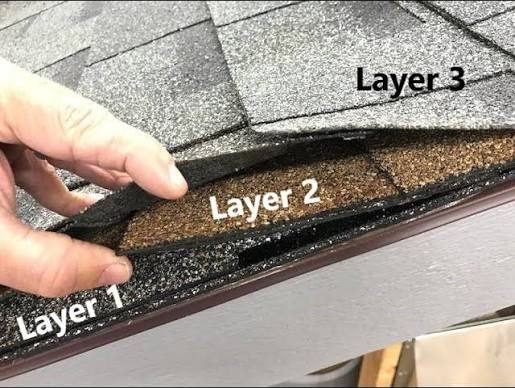
1. Look at the rake edge (the sloped edge at the side/gable of the house). One layer looks like a single thin shingle edge; two layers look stacked, stepped, and noticeably thicker.2. Lift a shingle at the gutter. Gently lift the bottom row at the eave — if there is another shingle layer underneath instead of drip edge and underlayment on wood, you have multiple layers.
Lifting at the gutter — this roof has three buried layers (labeled 1, 2, 3)
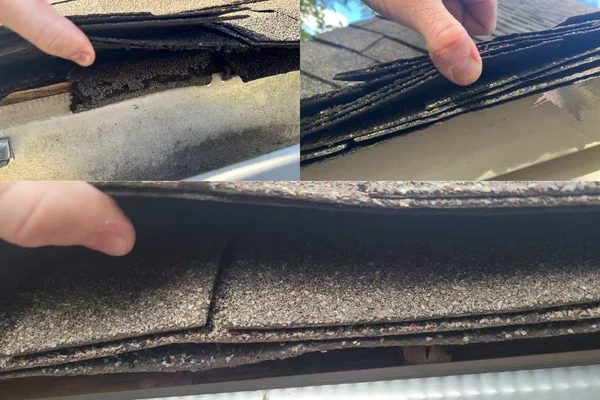
3. Count the edges. At the eave or rake, count the distinct shingle edges stacked on each other — every edge is a layer.
Count the distinct shingle edges stacked at the eave or rake — every edge is a layer
Layers can be hidden. Some prior roofers mask a second layer: fascia/rake aluminum bent over the old edge plus new ice & water shield and drip edge can make two layers look like one from the ground. If we begin work and discover layers that were not visible, removal and disposal of each additional layer is an added charge of $70 per square per layer by written change order.
Warranty limitations on a layover
Wall & endwall transitions are excluded from warranty. A layover installs the new shingles on top of your existing roof, so the water barrier (ice & water shield) and the flashing details at endwall and sidewall transitions — where the roof meets walls, chimneys and dormers — are not rebuilt. Because those details stay buried under the new layer, they cannot be proven watertight, and leaks at those transition points are excluded from the warranty.
Base warranty only + 2-year labor warranty. Higher-tier manufacturer system warranties are not permitted on a layover — only the manufacturer's base warranty applies. The Reisch workmanship (labor) warranty on a layover is 2 years. A full tear-off & replacement unlocks the premium warranty tiers and our longer workmanship coverage.
Not sure? No problem — every layover includes a pre-install Reisch inspection, and final eligibility is confirmed on-site before any work begins.
Flat roof recover — is it an option for you?
Please read — this protects your project and your wallet.
What is a recover?
The new roof (insulation board + membrane) is installed over your existing flat roof with no full tear-off — faster and about $50/sq less. Unlike a shingle layover, wall, curb and penetration flashing details are rebuilt as part of the new flat system — transition points are not an issue on a flat recover.
The one-assembly rule. Building code allows a recover only when there is a single existing roof assembly (IRC R908.3 / IBC 1511.3) — two applications is the maximum — and only when the existing roof is dry. Water-soaked insulation must be removed, not covered over.
Already have 2 layers? A recover is not permitted by code — but a full replacement is not your only option. A silicone restoration coating can often be installed over the existing roof at a lower cost than replacing it. Reisch installs silicone roof systems — ask us to price that option.
How eligibility is confirmed
Reisch performs a pre-install inspection with a moisture check (and a core cut where needed) to confirm one dry assembly. Your quote is contingent on that approval.
How layers are checked on a flat roof
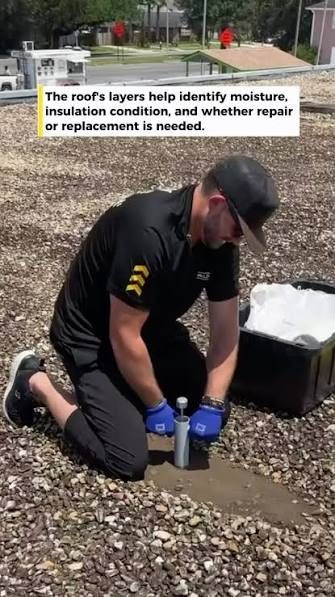
1. The core-cut tool. A core cutter removes a small plug of the roof down to the deck — the definitive way to count assemblies and check the insulation.
The core-cut tool — it removes a small plug of the roof down to the deck
2. The core cut. The plug shows every layer, the insulation condition, and any trapped moisture.
A core cut in progress — the plug reveals moisture, insulation condition and layer count
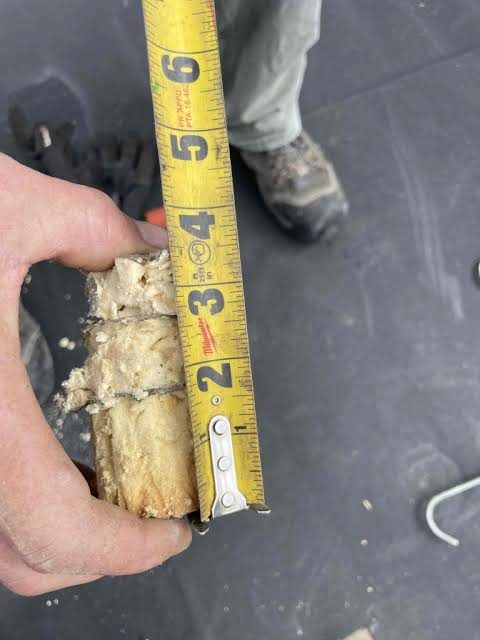
3. Measure & inspect. The core is measured and inspected before we quote a recover.
Measuring the core sample — buried layers and wet insulation show immediately
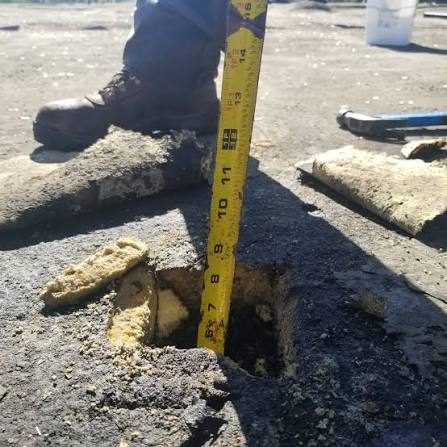
The core opening confirms exactly how many assemblies are on the roof
Concealed conditions. If a second membrane, wet insulation, or a deteriorated substrate unknown to us is discovered once the roof is opened, removal and disposal is an added charge of $125 per square per additional roof layer plus $90 per square per layer of insulation, by written change order.